Pose guide
How to improve your Warrior I
Front knee over the ankle at a right angle, back heel down, hips facing forward, arms reaching straight up. Here’s the rubric Posewise measures it against, and what to train when you miss.
The rubric
Posewise checks nine things, from the side and the front. Here’s what good looks like.
- Front kneeBent to a right angle, over the ankle80–100°hip · knee · ankle
- Back legStraight and strong165–185°hip · knee · ankle
- Back heelPressed into the matDownheel vs toe
- TorsoTall, stacked over your hips0–12°lean from vertical
- HipsFacing forward, with your chestSquarefront view
- Knee trackingOver your front foot, not caving inIn linefront view
- ArmsStraight up, in line with your ears155–185°hip · shoulder · elbow
- ShouldersLevel, both arms at the same height0–9°tilt
- HandsReaching through the fingertipsLongwrist to fingertip
What’s holding it back
Build quad and glute strength, and your front knee will reach a 90° bend.
The shape is there, the depth isn’t. That usually points to leg strength, not technique.
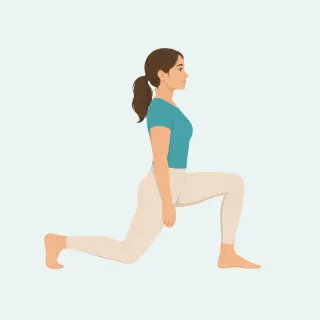 Split squats8 a side
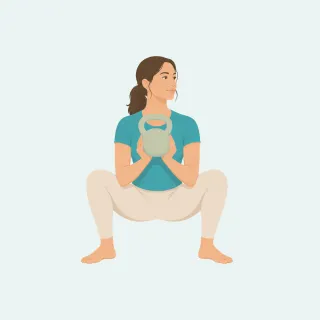 Goblet squats12 reps
Bend your front knee toward 90°, right over your ankle.
Lengthen your calves, and your back heel will stay down and your back leg will straighten.
With the back heel grounded, tight calves usually lift the heel or pull the back knee into a bend. Shorten your stance until they ease.
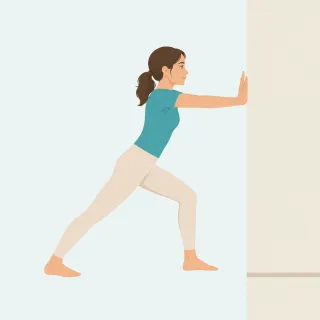 Wall calf stretch20s a side
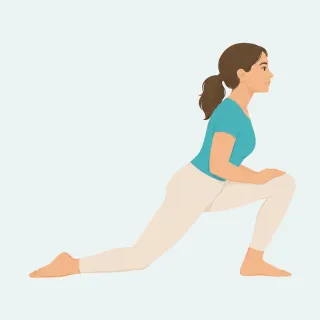 Ankle mobility drill10 a side
Press your back heel down into the mat.
Lengthen your hip flexors, and your torso will stay tall and your hips will turn toward the front.
Tight hip flexors on the back leg tip the pelvis forward and pull that hip open, so the chest leans and the hips twist.
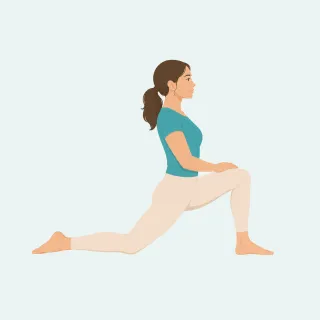 Low lunge stretch30s a side
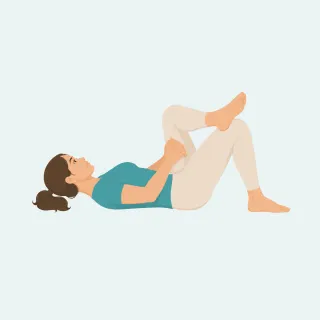 Figure-four stretch30s a side
Draw your back hip forward and lift your chest.
Strengthen your outer hips, and your front knee will track over your toes.
When the outer glutes are weak, the front knee caves in toward the big toe.
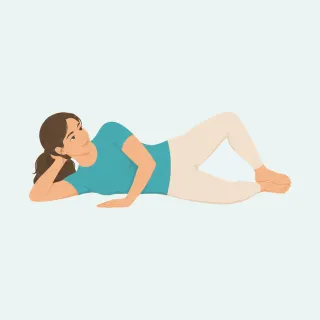 Clamshells12 a side
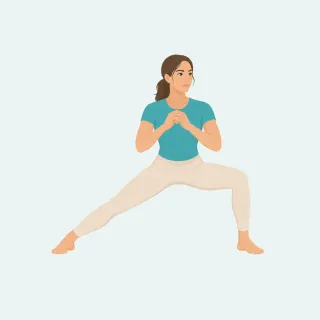 Lateral step-outs10 a side
Track your front knee out over your middle toe.
Free up your shoulders, and your arms will reach straight up, in line with your ears.
When shoulder range runs out overhead, the arms angle forward, one side rides higher, or the shoulders creep toward the ears.
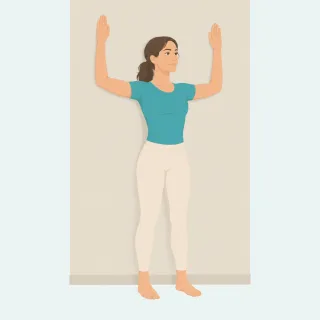 Wall slides10 reps
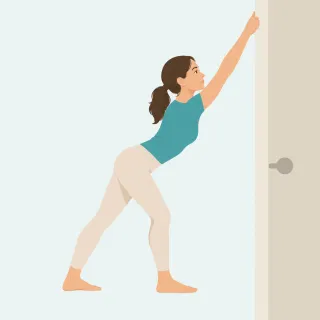 Doorway lat stretch20s a side
Reach your arms up in line with your ears, through your fingertips.
Not sure which one is yours?
Posewise watches your Warrior I through your iPhone camera, tells you which of these is holding you back, and builds a six-minute daily plan to fix it. Video never leaves your phone.
Join the betaFree during the beta · iPhone
Quick answers
Should my back heel be down?
Yes. Turn your back foot out about 45° and press the heel into the mat. If it won’t stay down, shorten your stance; a lifted heel turns the pose into Crescent Lunge.
Do my hips need to be square?
Point them forward as far as is comfortable, but most bodies can’t fully square them with the back heel down. Stepping your feet a little wider apart, hip-width rather than heel to heel, helps.
Why does my lower back hurt?
Usually tight hip flexors on the back leg tip the pelvis forward and arch the low back. Shorten your stance and draw your tailbone down as you lift your chest.
What’s the difference between Warrior I and Warrior II?
Warrior I faces the front with your arms overhead. Warrior II opens your hips and chest to the side with your arms out at shoulder height.
How can I check my Warrior I form at home?
Film yourself from the side and the front. Or use Posewise, an iPhone app that measures your Warrior I with the camera, speaks corrections as you hold it, and builds a six-minute daily plan for what it finds.